Dr. Veselinović’s dental clinic consists of a team of dedicated, diligent and passionate professionals, educated to work in various areas of dentistry.
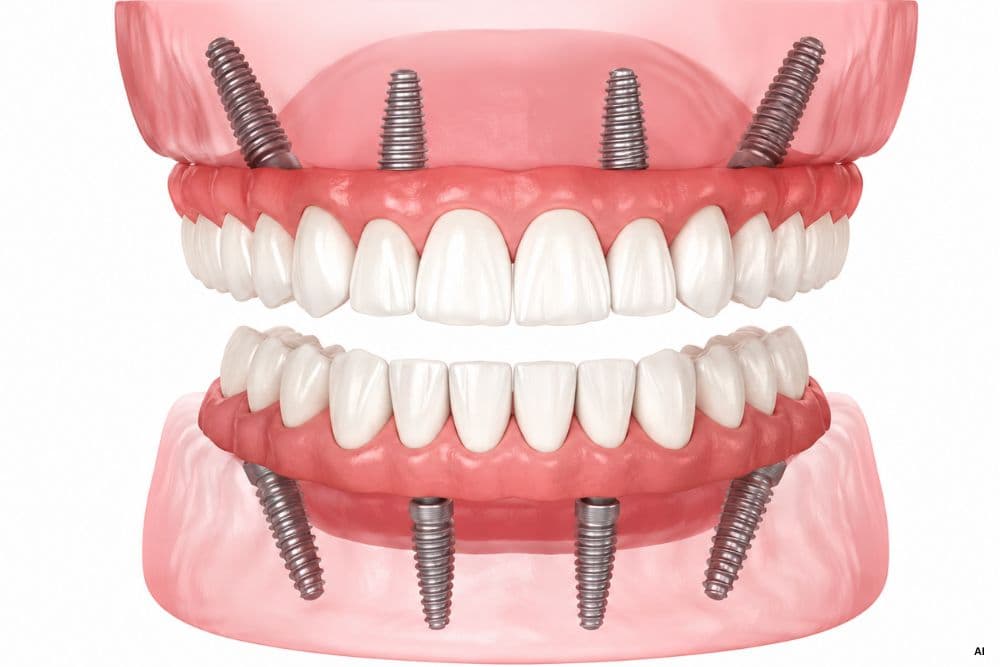
All-on-4 is a universal dental term which refers to the procedure of placing all teeth on four implants. It is an implant-prosthetic concept in which the entire jaw – upper or lower – rests on four carefully placed dental implants.
In which cases is the all-on-4 system applicable?
Losing all or most teeth no longer means that you have to wear a conventional removable denture, which is often associated with negative connotations. Modern implantology now enables fixed restorations that restore chewing function, speech, and aesthetics. One of the best-known and most widely used concepts is all-on-4 („all teeth on four implantsˮ).
Photo: Vecteezy, Okan Akdeniz
This system was developed to provide completely edentulous patients, as well as patients whose teeth cannot be saved, with a stable, long-lasting, and more financially accessible solution compared with placing a larger number of implants. It is particularly suitable for patients whose jaws do not have enough bone to support six implants.
Numerous clinical studies and dental practices worldwide confirm that this is a reliable method with a high success rate and a high level of patient satisfaction.
What is the all-on-4 system?
All-on-4 is an implant-prosthetic system in which, as mentioned above, the entire jaw is supported by four implants. Dentists place the two front implants vertically, while they place the two rear implants at a specific angle, most often around 30–45°. This arrangement maximizes the use of the existing bone tissue and eliminates the need for additional surgical procedures, such as jawbone augmentation or sinus lift (sinus floor elevation).
Thanks to this implant arrangement and positioning, dentists can create a strong foundation for a fixed prostheticrestoration that covers the entire jaw and provides excellent force distribution during chewing. The prosthetic restoration most often consists of 12 evenly distributed teeth – six on the left and six on the right side of the central part of the jaw (from the „onesˮ to the „sixesˮ).
The implant-prosthetic treatment takes place in several carefully planned stages:
1. Examination and diagnostics
The first step includes a specialist examination of the oral cavity and an orthopantomogram, or digital imaging with an intraoral scanner. After analyzing the quantity and quality of the jawbone, the dentist determines whether the patient is a candidate for all-on-4. The dentist then develops a precise treatment plan.
2. Extraction of the remaining teeth (if necessary)
If the patient has teeth that cannot be saved because of advanced periodontitis, extensive damage, or other reasons, the dentist extracts them immediately before placing the implants.
3. Placement of four implants
The dentist surgically places the implants into the jawbone under local anesthesia or, when necessary, conscious sedation. These small titanium or zirconium screws replace the roots of natural teeth.
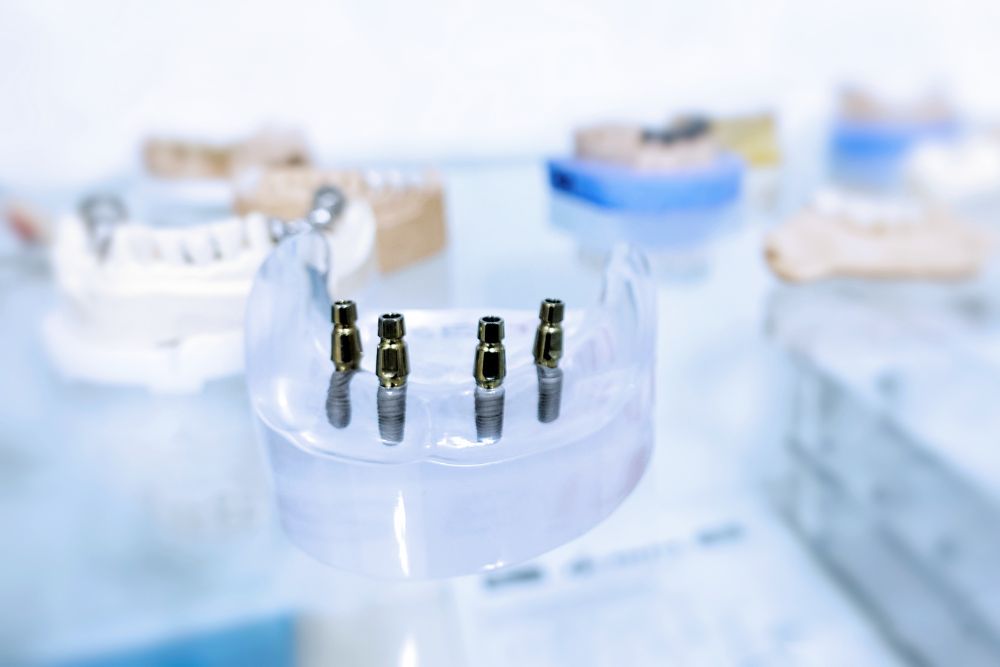
The dentist then places special prosthetic components, known as abutments, onto the implants. The final prosthetic restoration is later placed and secured onto these components.
4. Temporary fixed restoration
If the implants achieve sufficient primary stability immediately after placement, the dentist can secure a temporary bridge with screws as early as the same day or the following day, according to the patient’s wishes. This is why people often call the concept “teeth in one day,” although the treatment is not yet complete at that stage. Nevertheless, many patients who meet the above-mentioned conditions choose temporary teeth so that they can go through the entire process more comfortably and easily.
How long does it take for implants to fuse with the jawbone (osseointegration)?
After implant placement, the most important biological phase begins – osseointegration (Latin os, bone, and integrare, to join), meaning the fusion of the implants with the jawbone.
In the lower jaw, this process most often takes 3–4 months. In the upper jaw, it usually takes 4–6 months because the bone is softer and less dense. During this period, the patient uses a temporary fixed restoration. The dentist also recommends avoiding very hard foods and maintaining regular oral hygiene.
After osseointegration is complete, the dentist takes precise impressions or digital scans, creates the final prosthetic restoration, and permanently secures it to the implants with screws.
Photo: System all on 4 – procedure, patient of Dr. Veselinović Dental clinic
If maintenance or any correction becomes necessary, the dentist can simply unscrew the restoration without damaging the implants.
The total time from the first intervention to the placement of the definitive restoration usually takes 4–6 months. However, it may take less or more time depending on the condition of the bone and the individual healing process.
What materials can implants and prosthetic restorations be made of?
Most implants today are made of medical-grade titanium, a material that has been used in implantology for decades because of its excellent biocompatibility, strength, and ability to fuse with bone.
Dentists can also use zirconium implants in certain patients. These implants are white, highly aesthetic, especially in the anterior aesthetic zone, and provide an alternative for people with specific requirements or rare cases of metal hypersensitivity.
Dentists can make the final prosthetic restoration from various materials:
acrylic with a metal or titanium base;
composite materials;
porcelain-fused-to-metal;
monolithic zirconia;
multilayer ceramic materials based on zirconia.
The choice depends on aesthetic requirements, chewing forces, the available budget, and the recommendation of the dentist.
Advantages of the all-on-4 system compared with a removable denture
One of the main reasons patients choose all-on-4 is the feeling of having fixed teeth again.
Unlike a conventional removable denture, all-on-4 has the following characteristics:
it does not move during speaking or chewing;
it does not fall out of the mouth;
it does not require denture adhesives;
it does not cause the characteristic irritation caused by movement;
the patient does not remove it during the day or overnight;
it enables safer and more efficient chewing;
it contributes to more natural speech, greater self-confidence, and greater satisfaction.
Another important characteristic of implants is that they transfer chewing forces to the bone. This slows down bone resorption, which is otherwise particularly pronounced in patients who wear removable dentures for many years.
Difference between the all-on-4 system and implant-supported dentures
It is important to distinguish the all-on-4 system from an implant-supported removable denture.
An implant-supported denture rests on 4–6 implants, but the patient can remove it for cleaning. It works through a snap-on mechanism and provides significantly greater stability than a conventional denture. However, it remains a removable restoration.
On the other hand, the prosthetic restoration in the all-on-4 system is completely fixed with screws. Only a dentist can remove it during regular check-ups or repairs.
This is precisely why most patients perceive this concept as the option that most closely resembles natural teeth.
Who is the all-on-4 system intended for?
All-on-4 is particularly popular among older patients, but also among younger people who have lost all or most of their teeth due to periodontal disease, trauma, or other conditions and diseases.
Photo: Magnific, Pressfoto
The popularity of this system has continued to grow in recent years because it offers:
fewer implants compared with conventional full-mouth rehabilitation;
severe osteoporosis accompanied by specific medication therapy;
severe healing disorders;
active infections in the oral cavity;
insufficient jawbone volume.
Therefore, detailed diagnostics and an individualized treatment plan are essential for long-term success.
Oral implantology and prosthodontics at Dr. Veselinović Dental clinic
All-on-4 undoubtedly represents one of the greatest achievements of modern implantology because it allows the dentist to replace an entire jaw using only four implants and a fixed prosthetic restoration. Compared with conventional removable dentures, it provides significantly greater stability, comfort, security during chewing, and a more natural feeling in the mouth. When dentists plan, perform, and maintain the treatment correctly, this system can provide a long-term, functional, and highly successful aesthetic solution that significantly improves patients’ quality of life.
The experience of the oral implantologists and prosthodontists at Dr. Veselinović Dental clinic shows a very high implant and prosthetic restoration survival rate. For this reason, all-on-4 is now one of the standard methods for rehabilitating our completely edentulous patients.
If you are considering a solution for complete tooth loss, the best option is to schedule an examination and consult our experts. Only then can you get a complete picture of what is possible in your specific case and which solution is most appropriate for your individual situation.



Comments
[…] All-on-4 and All-on-6 systems (all teeth on 4 or 6 implants) are used for patients who have lost all or […]