Dr. Veselinović’s dental clinic consists of a team of dedicated, diligent and passionate professionals, educated to work in various areas of dentistry.
Causes of dental injuries and basic classification
All dental injuries can be divided into two main groups:
traumatic;
atraumatic.
Traumatic dental injuries
Traumatic dental injuries (teeth and periodontal tissues) always occur suddenly as a result of an accident. Therefore, children are more susceptible (especially boys), but adults are not completely excluded either. Those with orthodontic anomalies (for example, protruding, displaced incisors) or extensive carious lesions are particularly predisposed to these injuries.
Sports activities (martial arts and other contact sports, rugby, and similar activities) carry the highest risk of injury in general, and especially of injuries to the teeth and jaws. Traumatic injuries caused by impacts may occur even when protective helmets and chin and mouth guards are properly worn.
It is particularly important to emphasize that the number of traumatic injuries caused by riding electric scooters is constantly increasing.
This new urban means of transportation has become highly popular both locally and worldwide because it reduces traffic congestion and pollution. However, legal regulations regarding the rules of its use have not been precisely defined. Therefore, accidents caused by collisions between scooter riders and pedestrians, cars, buses, and various obstacles are frequent.
During collisions and falls, injuries most often affect the extremities and/or maxillofacial structures (the face, head, and neck). Teeth and jaws almost regularly suffer injuries in such situations.
The specialists at Dr Veselinović Dental clinic frequently encounter such injuries, mostly among younger patients aged 10–14 years. What they all have in common is that they ride scooters without protective equipment (helmets and chin guards).
It is also important to point out that such injuries represent a major burden on the healthcare system, as well as on the finances of the injured person.
Therefore, preventive measures are always a better solution than specialized treatment in dental and other medical offices.
What are other causes of traumatic dental injuries?
Dental trauma can also occur in a traffic accident, after a fall from a height, as a result of a physical fight, or due to a blow from a blunt object.
Biting very hard food or objects (almonds, bones, fruit pits, ice, bottle caps, and similar items) can also represent a traumatic factor.
Atraumatic dental injuries
When it comes to atraumatic dental injuries, they are usually indirect and caused by various diseases and conditions:
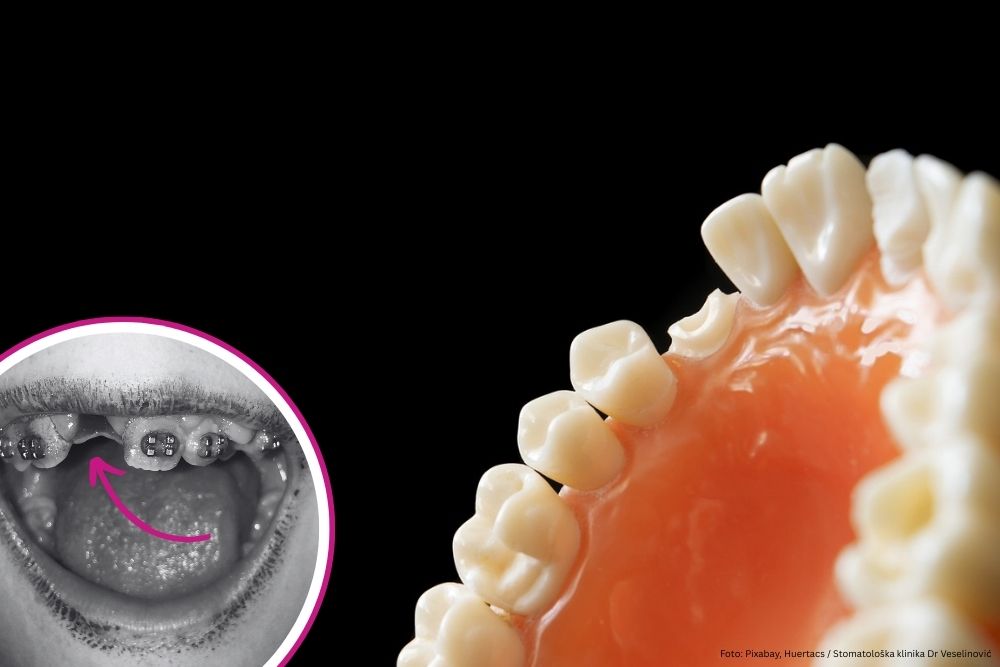
Dental injuries manifest themselves in several ways:
damage to the visible part of the tooth (enamel and crown);
damage to the internal parts (dentin, pulp, root, and alveolar bone);
tooth displacement;
avulsion.
Cracks and fractures (breaks) of the crown are the most common dental injuries. In addition to the crown, a fracture can also affect the tooth root, either vertically, horizontally, or diagonally.
A fracture can occur not only due to the effect of a strong direct force (impact), but also due to biting extremely hard food (almonds, fruit pits, walnut/hazelnut shells, unpopped popcorn kernels, bones) or objects (bottle caps, a small stone accidentally found in salad, and similar items).
When it comes to displacement, the tooth can be:
loosened (it moves and bleeds);
partially extruded (positioned above the level of the other teeth);
laterally displaced, with the alveolar bone also being injured;
pushed into the bone (positioned below the level of the other teeth);
Tooth avulsion – An example of treatment from our clinical practice
Tooth avulsion refers to the traumatic displacement of a tooth from its socket.
When this type of injury occurs, it is necessary to act calmly and quickly: immediately find the knocked-out tooth, place it in lukewarm salt water or milk, and visit a dentist within the first one to two hours.
If conditions do not allow the tooth to be placed in liquid, the patient can transport it in their mouth (under the tongue) or wrap it in a moist tissue or hydrophilic cotton.
If the tooth is dirty, do not clean it with chemical substances. Instead, gently rinse it only with cold water. Also, never hold the tooth by its root — hold it exclusively by the crown.
If the tooth is still attached to the jaw by the periodontal ligaments (small fibers), do not pull it out under any circumstances – leave it in the mouth!
It is extremely important to visit a dentist as soon as possible because only then can replantation be performed – returning the tooth to its socket.
In the photographs shown below, you can see an example of an avulsed and replanted tooth.
Photo: Avulsion and replantation of teeth, patient of Dr. Veselinović Dental clinic
The boy had fallen during a physical education class while wearing fixed orthodontic braces. He came to our dental clinic two hours after the injury.
The dentist repositioned the tooth together with the orthodontic archwire, hoping for a favorable outcome.
We perform regular follow-up examinations (after 2, 4, and 8 weeks, followed by examinations after 6 months and one year), during which we check the stability and vitality of the replanted tooth.
An essential part of follow-up examinations includes X-ray imaging performed in our radiology department using a low-radiation device specially designed for children.
Should you be afraid when a dental injury occurs?
Fear and panic are completely natural reactions to injuries of the dental apparatus. However, if you are well informed and know reputable dental professionals, there is no reason to be afraid.
Whether you need emergency intervention or you are planning dental treatment, you have someone you can rely on. Contact us and schedule your appointment.



Comments
[…] gum injuries or trauma; […]
[…] trauma or injuries of the jaw and teeth during sports activities, traffic accidents, impacts or falls; […]
[…] Read also: E-scooters and other causes of dental injuries >> […]