Dr. Veselinović’s dental clinic consists of a team of dedicated, diligent and passionate professionals, educated to work in various areas of dentistry.
The pendulum appliance is a modern fixed functional orthodontic appliance used to move the upper molars (back teeth) backwards, i.e., to distalize them.
This treatment method creates additional space in the upper jaw and represents one of the most effective solutions for certain types of malocclusion. It is especially effective for patients with Angle Class II malocclusion.
Orthodontists often use this type of appliance in adolescent patients to prevent potential complications related to jaw development.
Unlike some older orthodontic methods that required patients to wear external appliances, the pendulum appliance successfully moves teeth without the need for uncomfortable extraoral devices. This makes treatment considerably simpler, more comfortable and more acceptable for patients.
What is a pendulum appliance and what are its components?
The pendulum appliance is a fixed orthodontic appliance placed in the upper jaw (maxilla). It remains in the patient’s mouth throughout the entire treatment period.
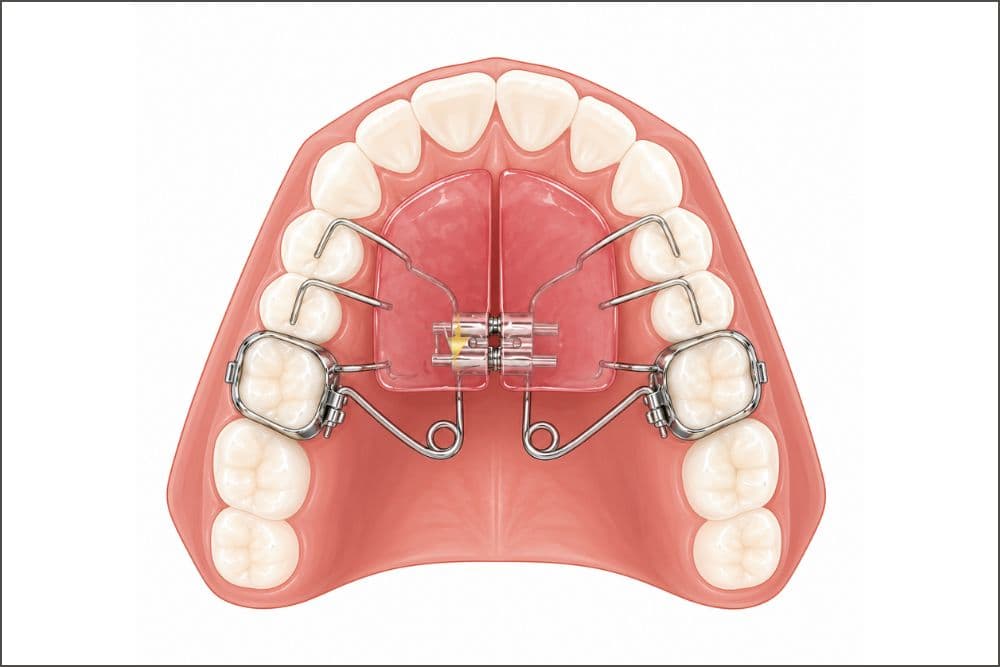
The appliance consists of an acrylic (plastic) button that rests against the hard palate and provides stable anchorage, as well as specially designed wire springs that connect the appliance to the teeth.
Photo: Pendulum appliance, AI
The springs are designed to generate continuous and controlled force. This force gradually moves the upper molars backwards. Only the orthodontist activates the appliance during regular check-up appointments. This approach ensures precise control of orthodontic forces and safe treatment progression.
The pendulum appliance remains in the mouth until the desired relationship between the upper and lower molars has been achieved. After that, treatment continues according to the individual treatment plan, most commonly with a fixed orthodontic appliance (traditional braces).
The most common indication for the pendulum appliance is the previously mentioned Angle Class II malocclusion. This condition is characterized by an improper bite in which the lower jaw is positioned further back (distally) in relation to the upper jaw. In this type of malocclusion, the upper teeth protrude excessively beyond the lower teeth, creating an increased horizontal overlap (overjet). This deformity, also known as an open bite, affects jaw function, smile aesthetics and facial profile harmony.
By distalizing the upper molars, the Pendulum appliance creates additional space within the dental arch. This allows orthodontists to align the remaining teeth properly without extracting them.
The best treatment results are achieved when orthodontists diagnose the problem early and begin treatment during the active growth and development of the jaws (up to approximately 18 years of age).
The recommendation to use the pendulum appliance in adolescents is based on the limited time available to prevent potential jaw development complications.
However, orthodontists can also use the pendulum appliance in selected adult patients, depending on the orthodontic diagnosis.
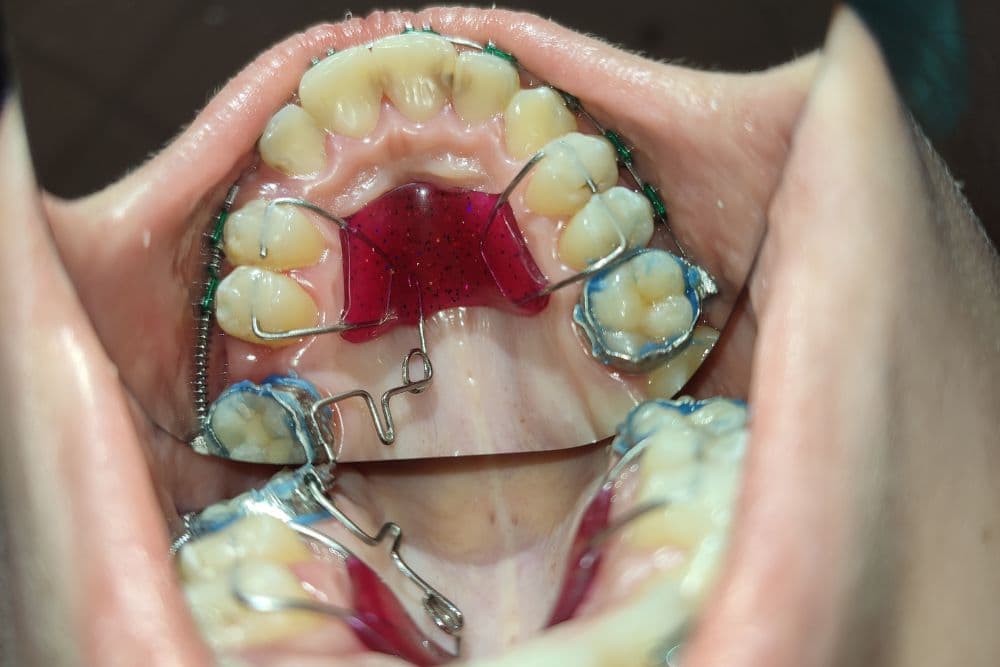
Photo: Patient of Dr Veselinović Dental clinic
The clinical case shown from Dr Veselinović Dental clinic demonstrates how far orthodontists can move the upper molars backwards. This movement creates the space required for proper alignment of the remaining teeth and helps achieve the desired bite relationship.
In clinical practice, the pendulum appliance offers numerous advantages compared to other molar distalization methods.
1. Greater efficiency in molar distalization
One of its greatest advantages is its highly effective ability to move the upper molars backwards.
The continuous force generated by the springs produces predictable results while maintaining excellent control over tooth movement.
2. The patient cannot remove the appliance
Another significant advantage is that patients cannot remove the pendulum appliance by themselves. Unlike removable appliances or external orthodontic devices, whose success depends heavily on patient compliance, the pendulum appliance works continuously, 24 hours a day. Its constant action and uninterrupted force make treatment more reliable. As a result, orthodontists achieve more predictable and often faster treatment outcomes.
3. Comfortable to wear
Patients generally tolerate the pendulum appliance very well. After a short adaptation period, most patients become accustomed to wearing the appliance. Speech and eating quickly return to normal and become completely natural.
4. Eliminates the need for external orthodontic appliances
Another important advantage of the pendulum appliance is that it often eliminates the need to wear external orthodontic appliances. In the past, these appliances represented the standard method for molar distalization. However, many patients considered them uncomfortable and aesthetically unacceptable.
5. Helps avoid premolar extractions
One of the greatest benefits of pendulum appliance therapy is the possibility of preserving healthy premolars. This advantage is particularly important because extracting healthy premolars often represents a major source of stress for young patients.
Fortunately, when orthodontists diagnose the problem early, they can often solve it successfully with a pendulum appliance.
Can a pendulum appliance prevent tooth extraction?
As mentioned above, one of the greatest advantages of pendulum appliance therapy is that it can help certain patients avoid the extraction of upper premolars.
In orthodontics, tooth extraction is sometimes the best or the only possible treatment option. However, when orthodontists can create sufficient space by moving the molars backwards, the pendulum appliance becomes an excellent alternative.
It is worth emphasizing once again that premolar extraction is a major concern for many young patients and their parents.
When orthodontists detect the problem early, pendulum appliance therapy can resolve the lack of space without tooth extraction in many cases. This approach often produces excellent functional and aesthetic results while preserving the patient’s natural dentition.
The pendulum appliance represents one phase of comprehensive orthodontic treatment. Once orthodontists achieve the desired position of the upper molars, treatment usually continues with fixed braces.
Braces allow orthodontists to align all teeth precisely, close existing spaces, establish a proper bite and complete the final shaping of the smile. The combination of the pendulum appliance and fixed braces delivers the best treatment outcomes for patients who require molar distalization and bite correction.
Patient responsibility still matters!
Although the pendulum appliance works continuously and patients cannot remove it themselves, treatment success still depends largely on good oral hygiene and regular orthodontic check-ups.
Patients should carefully clean their teeth, gums and the appliance itself, especially the acrylic button and wire springs. Proper hygiene prevents the accumulation of dental plaque, tooth decay and gum inflammation. Patients should also follow all recommendations provided by their orthodontist and attend regular follow-up appointments, during which the orthodontist activates the appliance whenever necessary.
Every patient is unique. Therefore, a comprehensive examination performed by Dr Jasna Veselinović, a specialist in orthodontics with decades of valuable clinical experience, represents the first and most important step toward choosing the most appropriate orthodontic treatment.