Dr. Veselinović’s dental clinic consists of a team of dedicated, diligent and passionate professionals, educated to work in various areas of dentistry.
Orthodontic mini-implants have appeared relatively recently, at the beginning of the 21st century. They were designed as a new, temporary tool for precise control of tooth movement during orthodontic therapy.
Because of this, they should not be confused with implants that serve as replacements for the roots of lost teeth.
Orthodontic mini-implants are used in more complex cases of bite irregularities correction. Specifically for asymmetrical tooth movements. Therefore, they are an excellent alternative to surgeries within orthognathic surgery.
In this sense, they represent a significant evolution of jaw orthopedics as a dental discipline.
The importance of this minimally invasive method is immeasurable, even within orthodontics itself. It is reflected in the increasingly rare use of orthodontic (chin) caps. And, cumbersome extraoral (external) appliances, known as headgear.
What do orthodontic mini-implants look like and what are their advantages?
Orthodontic mini-implants are screw-like devices made of biocompatible titanium. This material does not cause any immune system compromises or allergic reactions with bone and/or soft tissue.
The diameter of these orthodontic devices is very small, not exceeding 1.5–2 mm. And, their length can be up to 17 mm. They are composed of three components: the thread, the cervical part, and the head for the installation of wires and springs.
Orthodontic mini-implants serve as support for fixed prostheses. Significantly helping to reposition teeth into the occlusal plane and contributing to the shortening of therapy.
Their specificity lies in eliminating unwanted tooth movement and directing force only where it is needed. This is why they are also called skeletal anchors.
They are used to correct malocclusions (bite irregularities) such as deep bite, open bite, and crossbite, in multiple desired directions.
They also contribute to distalization (maintaining position). Meaning additional retention of teeth that need to remain stable during therapy.
Additionally, they support other important skeletal changes, such as the expansion of the upper jaw.
Installation of mini-implants in orthodontics
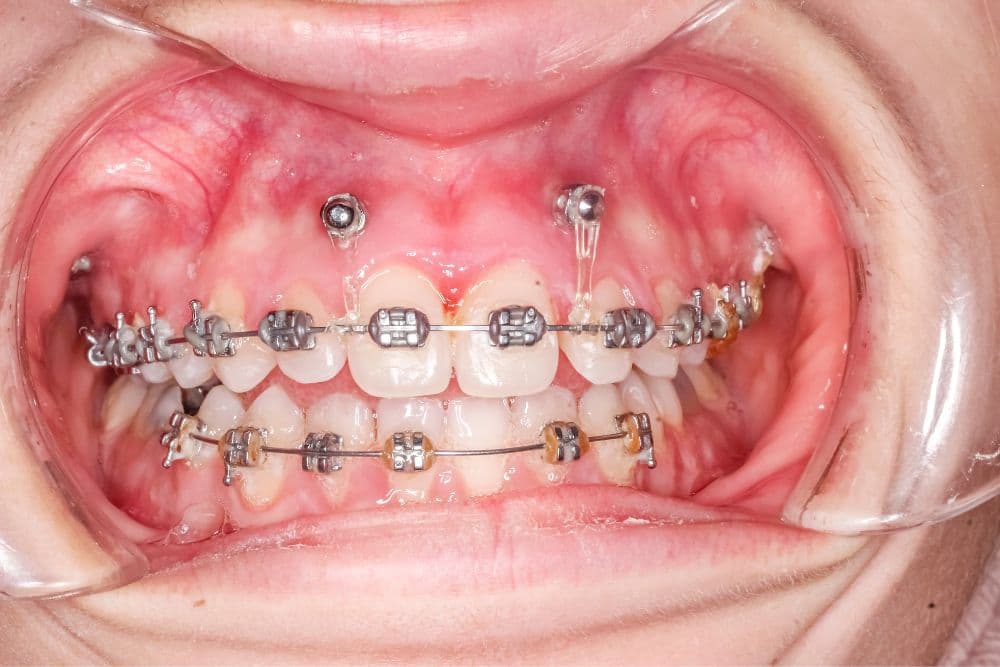
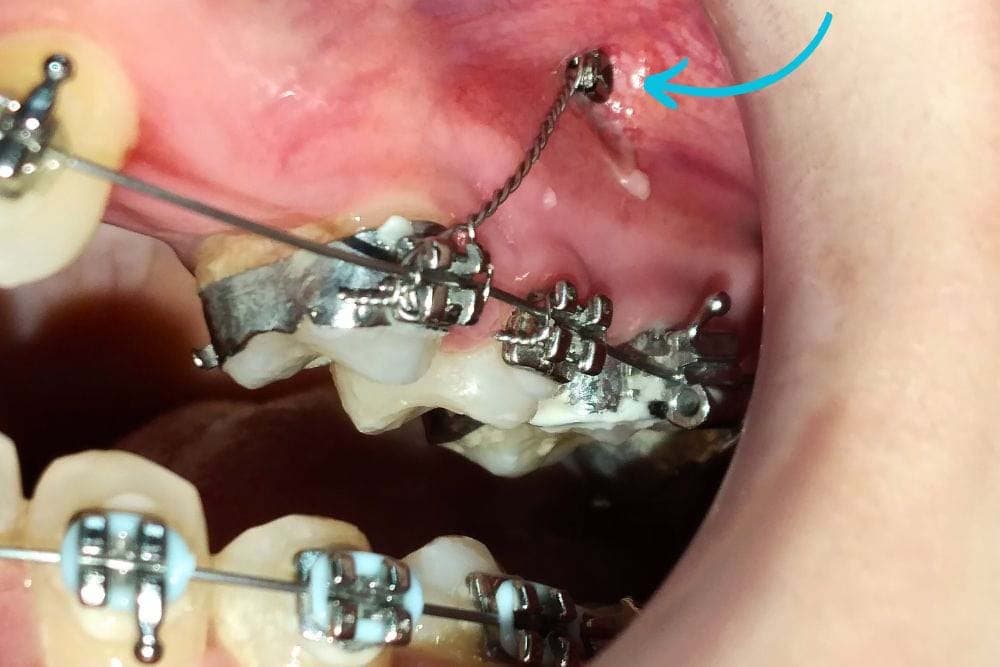
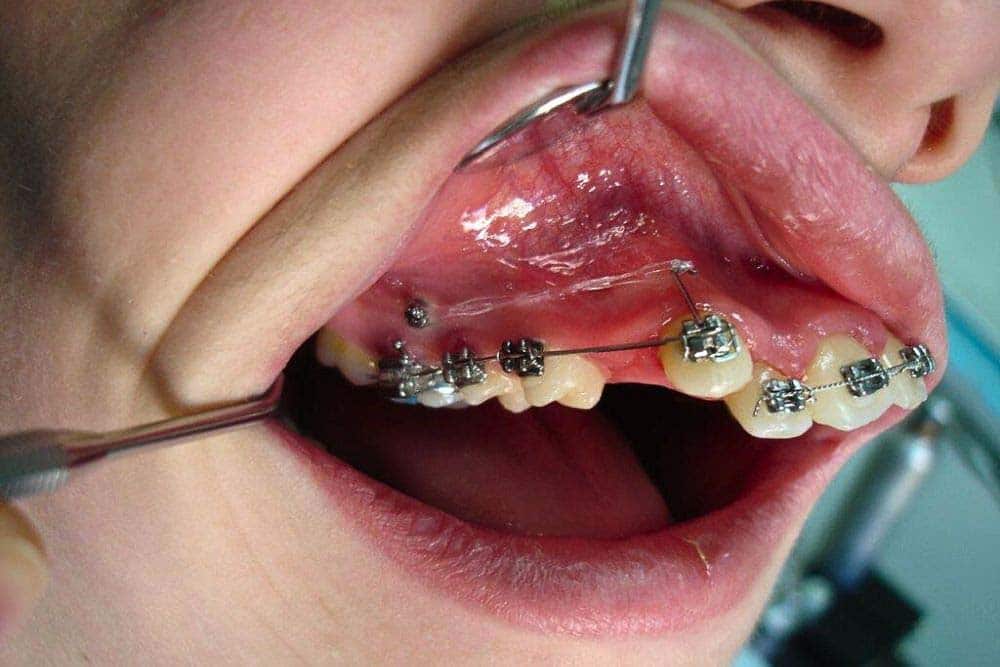
Orthodontic mini-implants are biomechanical elements that are inserted into the gingiva (gums), partially into the jawbone, and sometimes into the hard palate. They are usually placed in the posterior jaw region: between the first and second molars (back teeth), or the first molar and second premolar.
Their tip is located above the gum line. Allowing for the application of additional mechanical elements: rubber bands, wires, and chains.
Through their gentle force (combined with a fixed prosthesis), the teeth are moved into the correct position.
Photo: Dr Veselinović dental clinic
Before installation, the jaw orthopedic specialist determines the degree of malocclusion. And, based on an X-ray, analyzes the quality and density of the jawbone.
By selecting the most appropriate space for placement, they create a precise plan for the position, tilt, and torque of the mini-implants. At the same time, they choose the mechanics to achieve the best results.
When fixing mini-implants to the bone, special attention is given to the proximity of the tooth roots to avoid accidental injury.
After installation, an X-ray is taken again to ensure that the mini-implant is correctly placed.
What type of anesthesia is used for installation and removal?
This unique orthodontic anchorage procedure with micro-screws is performed under local anesthesia. It is painless, and patients do not need to be afraid of it.
It is important to emphasize that orthodontic mini-implants are discreet, hardly noticeable while wearing a fixed prosthesis. And, do not cause discomfort.
Photo: Dr Veselinović dental clinic
During use, proper maintenance is key, and (if necessary) plaque removal is essential to prevent complications like peri-implantitis (gum inflammation).
After therapy, they are easily removed by simply unscrewing, and the site where they were placed heals quickly.
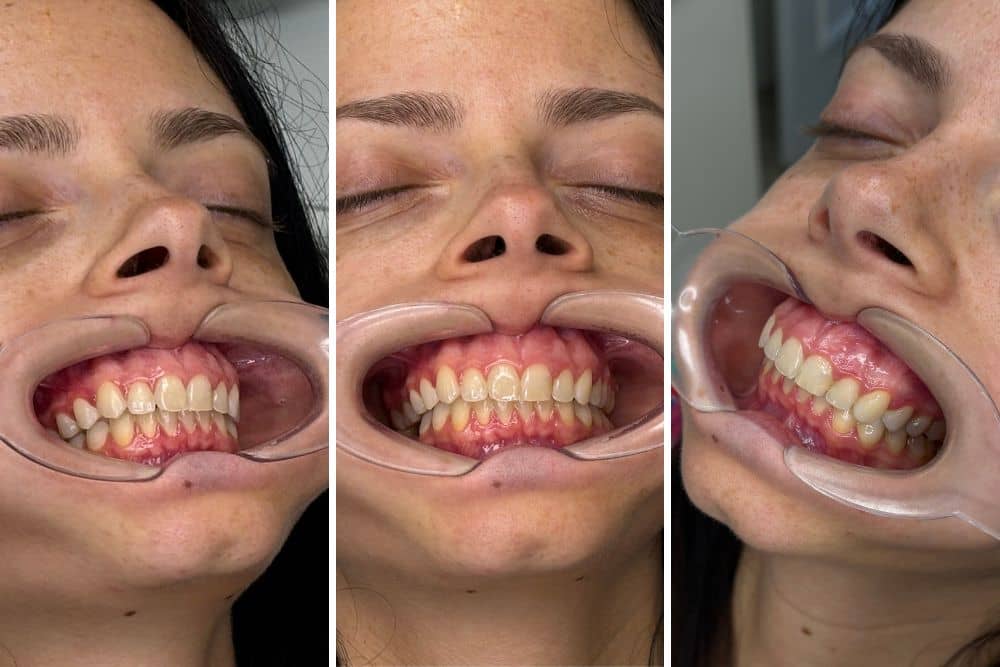
Just like with fixed prostheses, children, adolescents, and adults can wear orthodontic mini-implants if needed.
Photo: Dr Veselinović dental clinic
The jaw orthopedic specialist determines the type and course of therapy. So, mini-implants may be included where additional therapeutic support is required. This means a more precise and effective method for addressing complex orthodontic cases.
Dr. Jasna Veselinović is a specialist in jaw orthopedics with extensive expertise and exceptional achievements throughout her decades-long career. She deals with the diagnosis and treatment of tooth, jaw, and facial irregularities in children and adults.
Therefore, there is no room for hesitation or waiting: schedule a consultation with one of the best orthodontists in Montenegro. And, correct all dental irregularities in the best possible way.

Comments
[…] Read also: Mini-implants in orthodontics – For your perfectly straight teeth! >> […]
[…] Read more: Mini-implants in orthodontics – For your perfectly straight teeth! >> […]
[…] Read also: Mini-implants in orthodontics – For your perfectly straight teeth! >> […]