Dr. Veselinović’s dental clinic consists of a team of dedicated, diligent and passionate professionals, educated to work in various areas of dentistry.
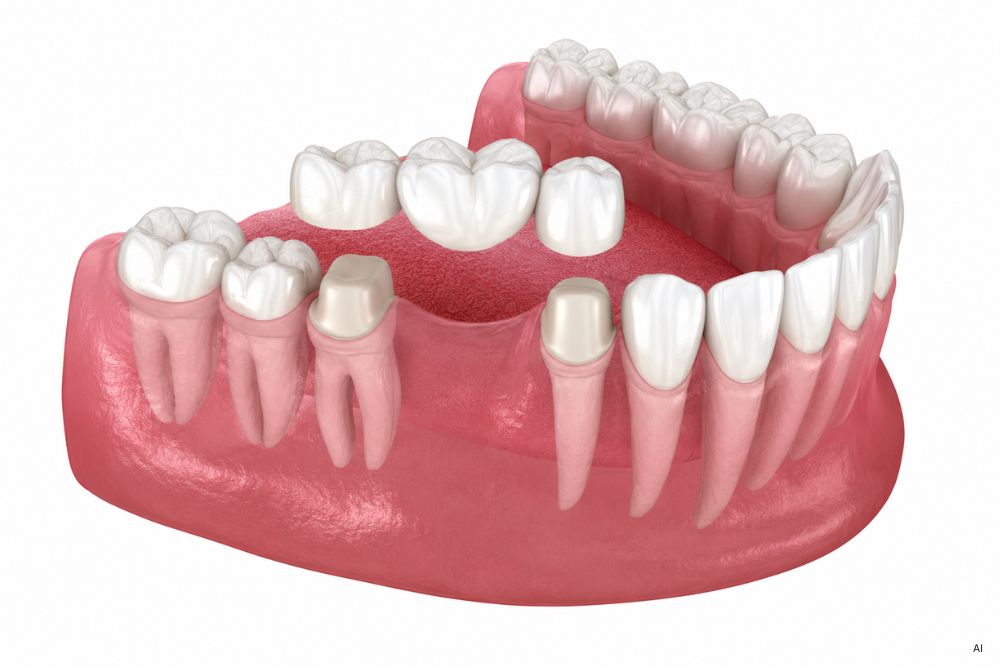
A dental bridge is a fixed prosthetic restoration that fills the space created by the loss of one or more teeth. Unlike removable dentures, a dental bridge is permanently cemented and the patient does not remove it during everyday activities.
The loss of one or more teeth is not only an aesthetic problem. Missing teeth can significantly affect chewing, speech, the position of remaining teeth and the health of the entire oral cavity. Modern dentistry offers several solutions for this problem, and one of the most common and reliable solutions is a dental bridge.
Photo: AI
Below, find out what a dental bridge is, when dentists recommend it, which types exist, how the fabrication process looks and what advantages it provides.
Why does tooth loss occur and when is a dental bridge needed?
There are several reasons why a person can lose one or more teeth. The most common causes include:
deep cavities and tooth decay that cannot be repaired;
complications caused by untreated infections and inflammatory processes;
periodontitis (periodontal disease), which leads to tooth loosening and tooth loss;
unsuccessful previous dental treatment and other causes.
Even the loss of a single tooth can cause the remaining teeth to move towards the empty space (tooth migration). This can lead to an incorrect bite, more difficult oral hygiene maintenance, excessive pressure on neighbouring teeth, root fractures and problems with the temporomandibular joint.
Therefore, dentists recommend replacing a missing tooth as soon as possible.
During the fabrication of the permanent restoration, the patient can wear a temporary dental bridge. This solution is important not only because it protects prepared teeth from cold and hot stimuli (air, liquids and food), but also because it provides better function and aesthetics during the waiting period.
Tooth preparation for a bridge
With a traditional dental bridge, dentists need to prepare and grind the neighbouring teeth that will serve as supports. During this procedure, the dentist removes a thin layer of enamel to create space for future crowns. The procedure is performed under local anaesthesia, which makes it generally painless.
It is very important that the teeth supporting the dental bridge are healthy or properly treated, with sufficiently strong roots and good bone support (jawbone with adequate density). If significant damage or infections exist, dentists must treat them beforehand. Teeth that cannot be treated need to be extracted.
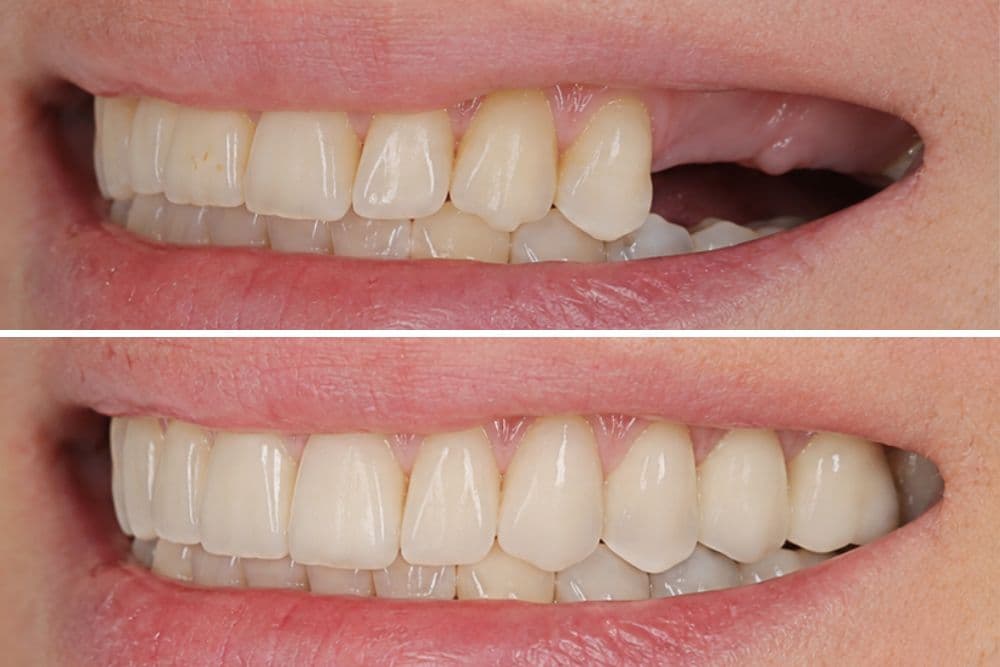
Photo: Patient of Dr Veselinović Dental Clinic, tooth extraction, sinus lift, implant placement and a new dental bridge
Info plus: Many patients choose dental implants instead of a traditional dental bridge because they want to avoid grinding healthy teeth.
However, in some cases, implant placement is the only possible solution due to the specific condition of the patient and the need to restore the dental arch.
Types of bridges
Modern dentistry offers many types of dental bridges, and the choice of a specific type depends on the characteristics of each individual case: the number of teeth that need replacement, the condition of the jawbone and other factors.
Bridges are classified according to:
construction and shape;
fabrication material;
placement area.
Construction and shape
According to their construction and shape, there are several types of dental bridges. The choice depends on several factors: the number of missing teeth, their position, the condition of neighbouring teeth, the amount of jawbone and the patient’s wishes.
The most common types include:
traditional (conventional) bridge – supported by natural teeth on both sides of the edentulous space;
cantilever bridge – supported only on one side;
Maryland bridge – a minimally invasive type of bridge used mainly for the anterior dental region;
implant-supported bridge – fixed on previously placed dental implants instead of natural teeth;
All-on-4 and All-on-6 systems.
Traditional bridge
A traditional bridge is supported on both sides by natural abutment teeth located next to the missing tooth area. To allow the teeth to support the crowns that hold the bridge, dentists need to prepare and grind them.
This type of bridge usually consists of three or more crowns physically connected into one unit. The connection between the crowns is not aesthetically visible, so they look like individual teeth.
This type of bridge provides long-term stability. Dentists most often fabricate it because of its high functionality, aesthetics and affordability. It is suitable for both anterior and posterior teeth.
Cantilever bridge
A cantilever bridge is specific because it relies on a supporting tooth only on one side, while the other side has no support.
A condition for making this type of bridge is the presence of two neighbouring abutment teeth that replace one missing tooth. The supporting teeth must be positioned behind the missing tooth in the dental arch.
The fabrication of this bridge is limited, and it has significantly lower resistance compared to a traditional dental bridge.
Maryland bridge
A Maryland bridge can replace only one missing tooth, mainly in the front areas of the jaws. It uses extensions (metal or ceramic wings) that attach to the back surfaces of neighbouring teeth.
The main advantage of this system is that it requires little or no grinding of healthy teeth (a minimally invasive method). It also provides excellent aesthetics and faster fabrication compared to a traditional dental bridge.
However, dentists rarely fabricate Maryland bridges because they have limited strength. Therefore, they are mainly placed in the anterior region, where chewing forces are the lowest.
Implant-supported bridge
Dentists most often recommend an implant-supported bridge when:
several consecutive teeth are missing;
there are not enough healthy natural teeth to support crowns.
Instead of natural teeth, this type of bridge attaches to dental implants and requires their previous placement.
An implant-supported dental bridge has specific characteristics regarding treatment planning and the transfer of chewing forces. Dentists make the crowns slightly narrower, and they often add a layer of pink ceramic that imitates the appearance of gums.
Photo: Magnific, Brgfx
The advantages of this implant-prosthetic solution include:
For prosthetic and implant rehabilitation of the jaws, the number of implants does not have to equal the number of missing teeth.
For example, four or six implants can support a bridge that replaces a larger number of teeth. This often makes the treatment more affordable.
The All-on-4 and All-on-6 systems (all teeth on 4 or 6 implants) are used for patients who have lost all or almost all teeth in one jaw.
The bridge attaches to 4, 6 or more implants and represents an alternative to a complete removable denture.
Materials
Dental bridges can also differ according to the materials used for their fabrication:
metal-ceramic bridge – a metal base covered with ceramic;
zirconia bridge – made from zirconium dioxide, highly strong and with excellent aesthetic qualities;
ceramic bridge – metal-free, providing excellent aesthetics, especially for front teeth;
lithium disilicate bridge – provides superior aesthetics for smaller bridges and the anterior region;
temporary acrylic or composite bridge – used during the fabrication of the permanent restoration.
Dental bridge placement area
Dental bridges can also differ according to their position in the jaw, meaning the area where dentists place them:
anterior dental bridge – used for incisors and canines;
posterior dental bridge – used for premolars and molars (for example, a bridge from the first premolar to the second molar);
full-arch dental bridge – covers a larger number or all teeth in one jaw.
What is the best choice when it comes to a dental bridge?
As with other dental treatments, there is no universal solution suitable for every patient. The choice of a dental bridge or another type of prosthetic treatment depends on:
the number of missing teeth;
the position of the edentulous space;
the condition of neighbouring teeth;
the quality and amount of bone;
the patient’s oral hygiene;
aesthetic requirements and expectations;
budget.
How long does a dental bridge last and how is it maintained?
With proper oral hygiene and regular dental check-ups, a high-quality dental bridge can last 10–15 years, and often much longer.
To ensure a long lifespan of a dental bridge, dentists recommend:
brushing teeth regularly at least twice a day;
using special dental floss or interdental brushes under the bridge;
professional removal of dental calculus (tartar);
dental check-ups at least twice a year.
Replacement of old dental bridges
Following the recommendations mentioned above is essential for the long-term durability of dental bridges. However, even the highest-quality dental bridges, with the best care and maintenance, cannot last forever.
Despite proper hygiene and regular maintenance, materials can wear out over time. Gum recession, secondary cavities under crowns or ceramic fractures can also occur.
Dentists recommend replacing an old dental bridge when the following problems appear:
loosening of the bridge;
unpleasant smell or taste;
pain or sensitivity of supporting teeth;
ceramic damage;
aesthetic changes;
cavities under the existing restoration.
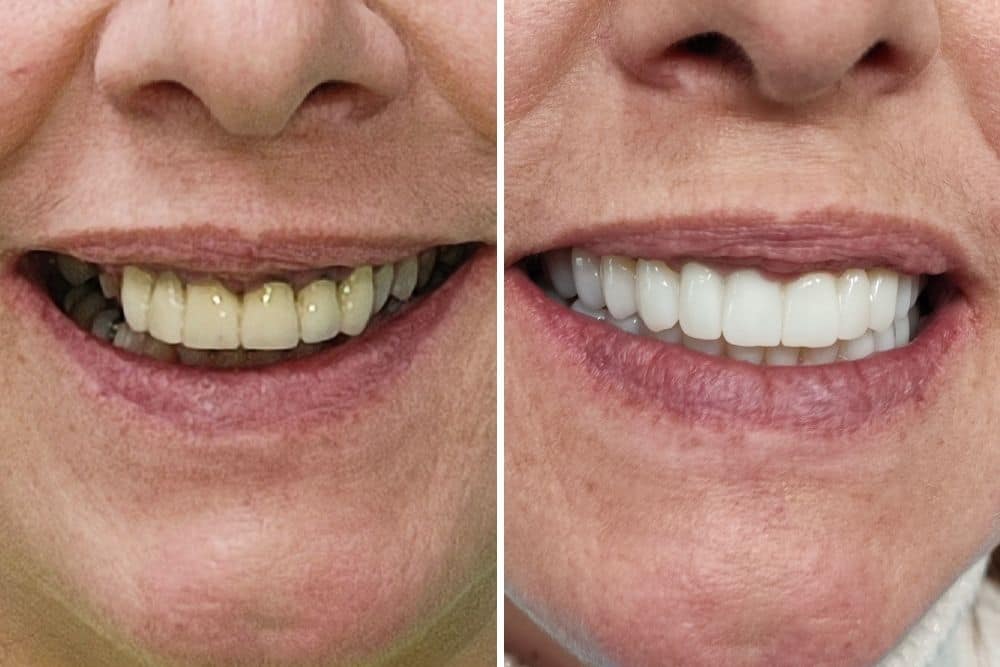
Photo: Patient of Dr. Veselinović Dental clinic, replacement of old bridges and a new smile
Before placing a new dental bridge, the dentist evaluates the condition of supporting teeth and, if necessary, suggests a more modern and efficient restoration, such as an implant-supported dental bridge.
Dentists recommend replacing old dental bridges every 10–15 years in order to prevent possible complications.
Dental bridges represent proven solutions that successfully restore missing teeth both functionally and aesthetically.
Whether the treatment involves a traditional dental bridge, cantilever bridge, Maryland bridge or implant-supported dental bridge, the choice of the most suitable therapy depends on the number of missing teeth, the condition of remaining teeth and the individual needs of each patient.
Timely replacement of missing teeth does not only contribute to a more attractive smile. It also preserves the health of the entire oral cavity, enables proper chewing and prevents numerous complications that can occur due to long-term tooth loss.
Therefore, after losing a tooth, it is important to contact a dentist as soon as possible. A dental professional will recommend a treatment adapted specifically to your situation.
If you are missing one or more teeth or you have any dental problems, do not try to guess which treatment option is right for you and do not delay treatment.