Dr. Veselinović’s dental clinic consists of a team of dedicated, diligent and passionate professionals, educated to work in various areas of dentistry.
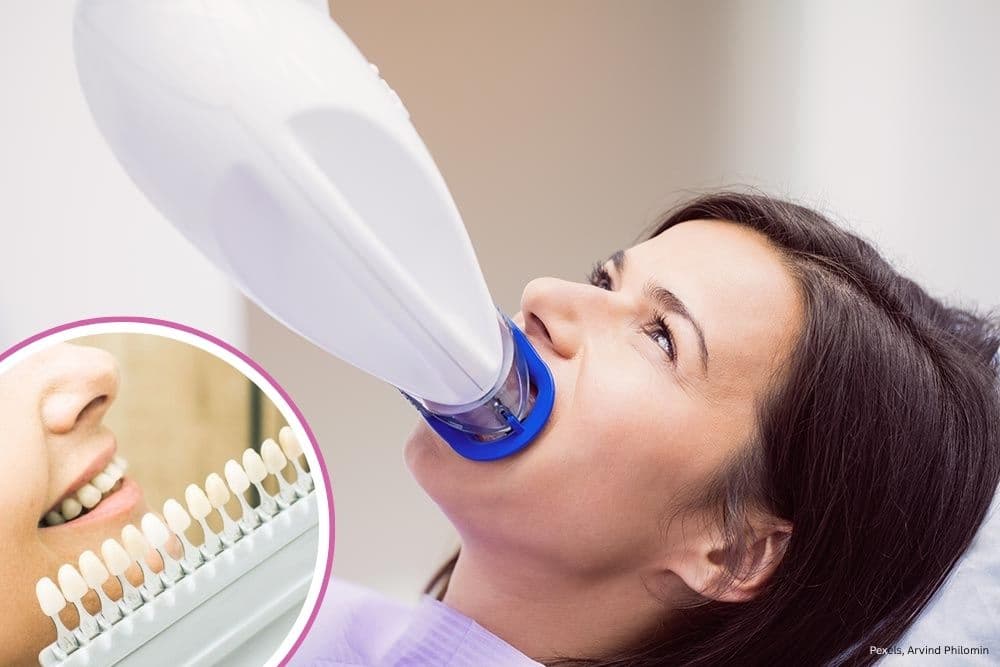
Laser teeth whitening is a professional aesthetic dental procedure that can significantly lighten the natural color of teeth. Dentists perform the procedure exclusively in a dental office after examining the teeth and gums and assessing their health.
What is laser teeth whitening?
Teeth whitening changes the optical and chemical properties of pigmented molecules in the tooth that cause a dark or yellowish color.
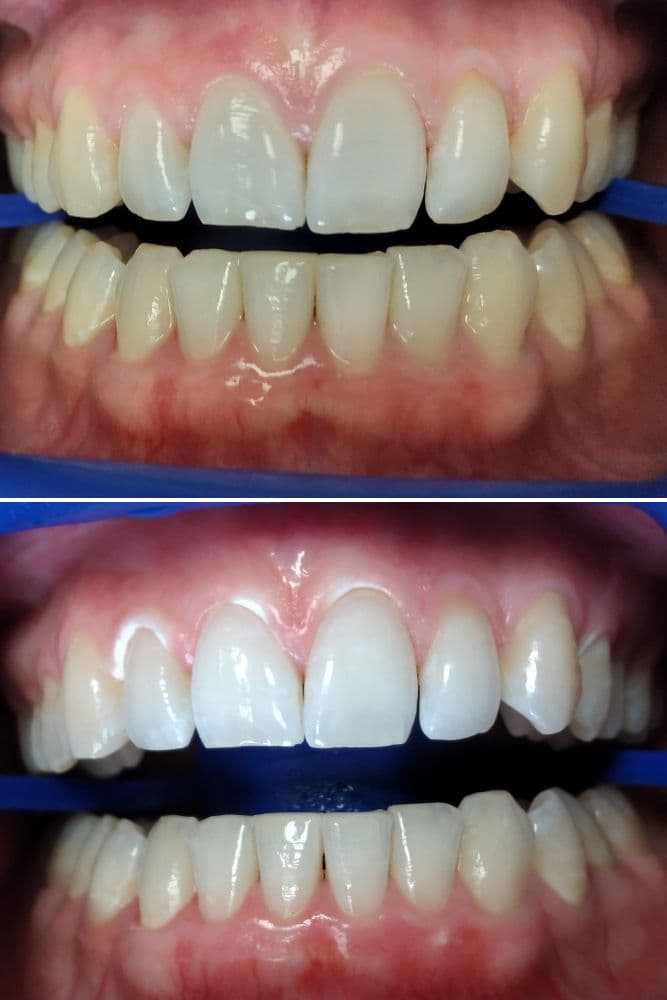
Photo: Patient of Dr. Veselinović Dental clinic, laser teeth whitening BEFORE and AFTER
Teeth can become darker throughout life for various reasons. Their color depends on aging, genetics, diet, coffee, tea, red wine, tobacco and other pigmented products. Discoloration can also develop inside the tooth after certain antibiotic treatments during tooth development, due to trauma or as a result of changes in the pulp and dentin.
Laser teeth whitening can affect both surface stains and certain internal discolorations. However, its effect depends on the cause and type of discoloration.
Professional laser teeth whitening is primarily intended for healthy, vital natural teeth (with a living nerve), including teeth:
with surface stains;
with color changes caused by certain internal discolorations;
where an aesthetic need exists to match the color with the other teeth.
However, being a natural tooth does not automatically make it suitable for whitening. Before treatment, the dentist must check the condition of the teeth, gums and supporting dental structures.
Teeth with large fillings, cracks, pronounced sensitivity, erosion, abrasion or caries require special attention. The same applies to other changes that may increase the risk of complications.
Can crowns, veneers and fillings be whitened?
The answer is no. Whitening changes the color of natural tooth tissue, but it does not change the color of existing ceramic or composite restorations in the same way.
composite fillings and other aesthetic restorations.
This is very important for patients with visible crowns, veneers or large fillings in the front dental region. After whitening, natural teeth may become lighter, while existing restorations retain their original shade. This can create a visible color difference between natural teeth and prosthetic or restorative work.
If complete aesthetic matching is necessary, the dentist may recommend whitening the natural teeth first. After the color stabilizes, the dentist can replace visible fillings, veneers or crowns with restorations in a suitable shade.
the patient’s expectations and realistic treatment options.
If the teeth have surface stains, tartar and plaque, the dentist first removes them with professional cleaning and polishes the teeth when necessary.
This step matters because whitening does not replace professional tartar and plaque removal. After removing these deposits, patients may already notice an improvement in the appearance of their teeth.
Before whitening, dentists should also treat active dental problems, especially caries and gum inflammation. Only when the teeth and soft tissues are healthy enough can the dentist assess whether laser whitening is safe. The clinical examination may also include additional diagnostics when necessary, such as an X-ray.
Professional whitening relies on a peroxide-based gel. Dental office whitening systems use different formulations and concentrations. Hydrogen peroxide is one of the most common active ingredients.
The process includes:
the action of the peroxide gel;
the release of reactive oxygen molecules;
the penetration of compounds through enamel and dentin;
the oxidation of pigmented molecules;
changes in their optical properties;
achieving a lighter tooth color.
Hydrogen peroxide breaks down and releases reactive oxygen species that oxidize chromophores, the organic molecules responsible for darker tooth color. These active compounds penetrate the tooth structure and reach pigmented molecules. They absorb less light, making the tooth appear lighter.
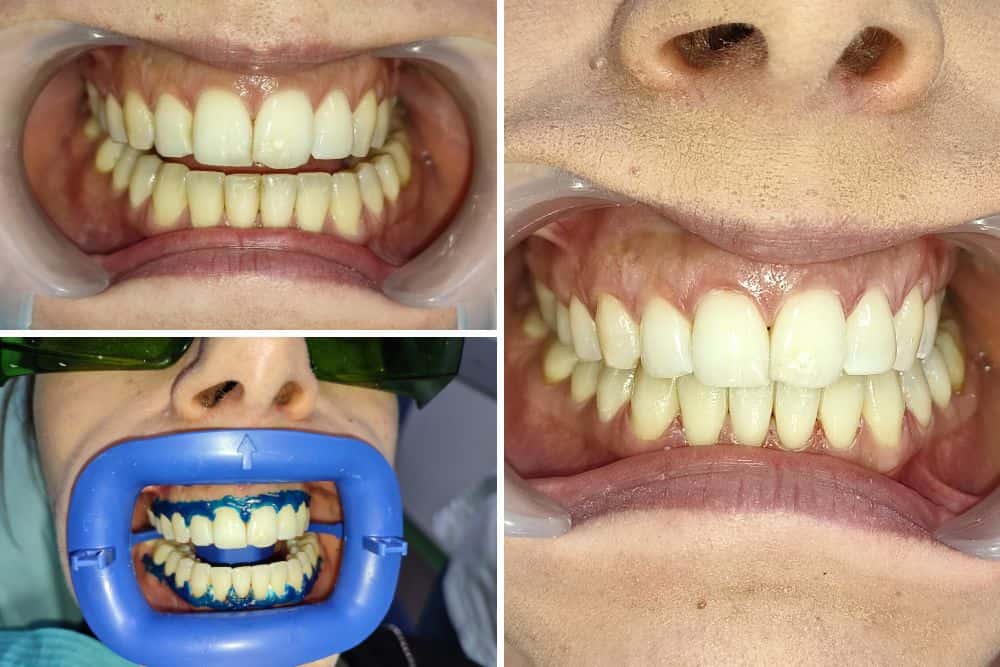
Photo: Patient of Dr Veselinović Dental clinic, laser teeth whitening BEFORE, DURING and AFTER
Therefore, it is not entirely accurate to say that the laser „removes stainsˮ from the teeth. The gel provides the chemical action, while the light source activates the process.
Is the laser essential for achieving a lighter tooth shade?
Some systems require light activation of the gel. Depending on the device, this may involve a laser, Zoom lamp or another light source.
However, whitening results depend mainly on the quality and concentration of the gel, proper soft-tissue isolation, contact time and the condition of the teeth.
Laser teeth whitening at Dr Veselinovic Dental clinic – Procedure and frequently asked questions
After the examination and tooth preparation, the procedure usually involves several steps.
1. Determining the initial tooth shade
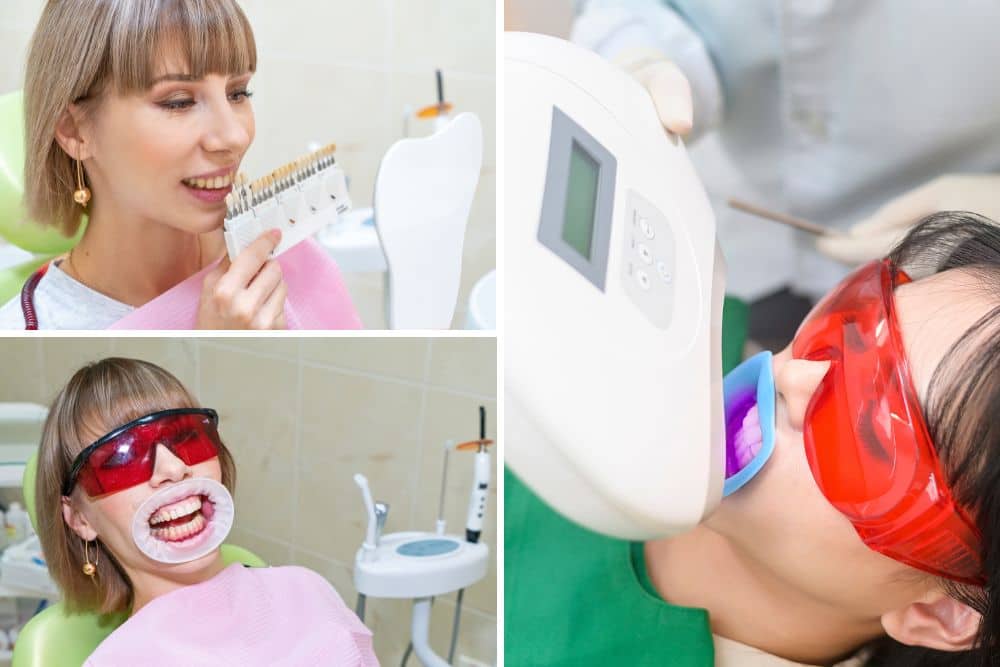
Before treatment, the dentist determines the initial tooth shade using a standard shade guide or digital device. The dentist may also take photographs before treatment to allow a more objective comparison of the initial and final shade.
Professional whitening uses active substances at relatively high concentrations. Therefore, protecting the gums and surrounding soft tissues is one of the most important parts of the procedure.
The goal is to keep the gel only on the intended tooth surfaces and prevent contact with the gums, lips and other soft tissues. Peroxide gel can cause temporary irritation if it contacts the gums, especially when the protective barrier is not properly placed.
3. Applying the gel
The dentist applies an appropriate amount of professional whitening gel to the front surface of the teeth. The concentration and exposure time depend on the product and procedure. A higher concentration does not automatically mean better results. Higher hydrogen peroxide concentrations can increase the risk of sensitivity.
4. Light activation
The teeth are exposed to an appropriate light source for a specific period. The dentist controls the position of the light source, exposure time and condition of the soft tissues.
5. Removing and (if necessary) reapplying the gel
In some cases, the dentist removes the gel after a specific period and applies a new amount. The dentist may repeat the process several times during one visit.
There is no universal treatment time or number of cycles for every patient. The procedure depends on the product, concentration, initial tooth shade and dentist’s assessment.
Why do both the patient and dentist wear protective glasses?
Eye protection is an important safety measure when using an intense light source or laser. The type of protective glasses depends on the wavelength and characteristics of the specific laser device. Therefore, the dental team uses protective equipment designed for that device.
How long does laser teeth whitening take?
The procedure usually takes approximately 45–90 minutes. However, the total time depends on the laser system, number of cycles, patient preparation and extent of treatment.
Some procedures take less time, while others require several consecutive gel application cycles. In some cases, additional visits may be necessary to achieve the desired shade.
How many shades can teeth be whitened?
The result cannot be guaranteed in advance. Some patients may experience a significant color change, while others may achieve a more limited result. In clinical practice, teeth commonly become 5–6 shades lighter.
As mentioned above, the result depends on the initial tooth color, cause of discoloration, tooth structure, patient age and individual response to the whitening agent.
What happens to tooth color after treatment?
Immediately after whitening, the teeth may look very bright. However, the shade stabilizes over the following days.
The longevity of the result depends on individual habits and oral hygiene. Smoking and frequent consumption of coffee, tea, red wine and other dark-colored foods and drinks can contribute to faster tooth staining.
Is laser teeth whitening painful?
The most common side effect is temporary tooth sensitivity, especially to cold stimuli. Hypersensitivity may occur during or immediately after treatment, but it usually subsides quickly.
Can the gums be damaged?
When the procedure is performed correctly, the gums are properly isolated and the gel is carefully controlled, damage should not occur. However, peroxide gel can cause temporary irritation if it comes into contact with the gums. Therefore, protecting the soft tissues is a key part of professional in-office whitening.
During the procedure, the patient should immediately inform the dentist if they feel burning in the gum area.
Aesthetic dentistry at Dr Veselinovic Dental clinic
In addition to laser teeth whitening, patients at Dr Veselinovic Dental clinic can request other cosmetic and restorative dental procedures:
Beautiful teeth are not simply white and bright. A stunning smile starts with healthy and functional teeth.
This is the mission of the clinic’s dental team Dr Veselinović: to use knowledge, experience and dedication to help people maintain the health and quality of their teeth for many years. This contributes not only to individual health but also to public health.